

Cyst removal at Advanced Skin Doctors is a quick, minor procedure performed under local anaesthetic. Our doctors examine each lump first, then remove the cyst along with its sac to reduce the chance of it returning. We treat epidermoid, sebaceous and pilar cysts at our Narre Warren, Wheelers Hill, Hoppers Crossing and Frankston clinics across Melbourne. No referral is needed, and same-day treatment is often available, with aftercare guidance provided.
Key takeaways
- Most cysts are benign and don’t need removal unless they cause problems.
- Excision (removing the cyst and its sac) is the definitive treatment; draining alone
often allows it to refill. - Some skin cancers can look like cysts, so any new or changing lump should be examined.
- Don’t squeeze or cut a cyst at home.
- You can book directly. No GP referral is needed.
Cyst removal at a glance
- Procedure Surgical excision of the cyst and its sac
- Anaesthetic Local (the area is numbed)
- Duration About 30 minutes or under 30 minutes
- Stitches Yes, usually removed after around 7–10 days, depending on location
- Back to normal Most people resume everyday activity quickly; avoid strenuous exercise until we advise
- Pathology Removed tissue can be sent for testing
- Referral Not needed
What is a skin cyst?
A skin cyst is a closed sac within or beneath the skin that may contain keratin, fluid or other material. Many are benign and stay small and painless for years. Others enlarge, become tender or infected, or sit where clothing, shaving or pressure irritates them.
Common Types of Cysts
- Epidermoid cysts are slow-growing lumps, common on the face, neck and trunk. They contain keratin and often have a small central opening (punctum). They’re widely called “sebaceous cysts”, but most lumps described that way are epidermoid cysts; true sebaceous cysts are uncommon.
- Sebaceous cysts are slow-growing lumps that develop beneath the skin and are often painless. They may become swollen, tender or uncomfortable if inflamed or irritated. If a cyst grows, causes discomfort or repeatedly becomes inflamed, a medical assessment can determine whether sebaceous cyst removal is appropriate.
- Pilar (trichilemmal) cysts arise from the outer root sheath of a hair follicle and are especially common on the scalp. They feel smooth and firm, often occur in groups, and can run in families.


Is it a cyst? How lumps compare
| Lump | Typically feels like | Key points |
|---|---|---|
Epidermoid cyst | Smooth, round, movable; may have a central dot | Slow-growing; can become inflamed or infected |
Pilar cyst | Firm, smooth, usually on the scalp | Often multiple; may run in families |
Soft, doughy, no surface opening | Lump of fatty tissue, not a sac | |
Red, hot, painful, may discharge | Infection needing prompt treatment | |
Can mimic a cyst: firm, fixed, ulcerated or bleeding | Needs examination and sometimes biopsy |
Appearance alone can’t confirm what a lump is. That’s why we examine first.
Does a cyst need to be removed?
Not always. A small cyst that isn’t causing symptoms can reasonably be left and monitored. Removal is worth considering when a cyst:
- is painful or repeatedly inflamed
- is growing or has changed
- has ruptured or been drained before and returned
- is constantly irritated by clothing, shaving, hair brushing or movement
- sits somewhere visible and bothers you
- hasn’t been diagnosed and you’re unsure what it is
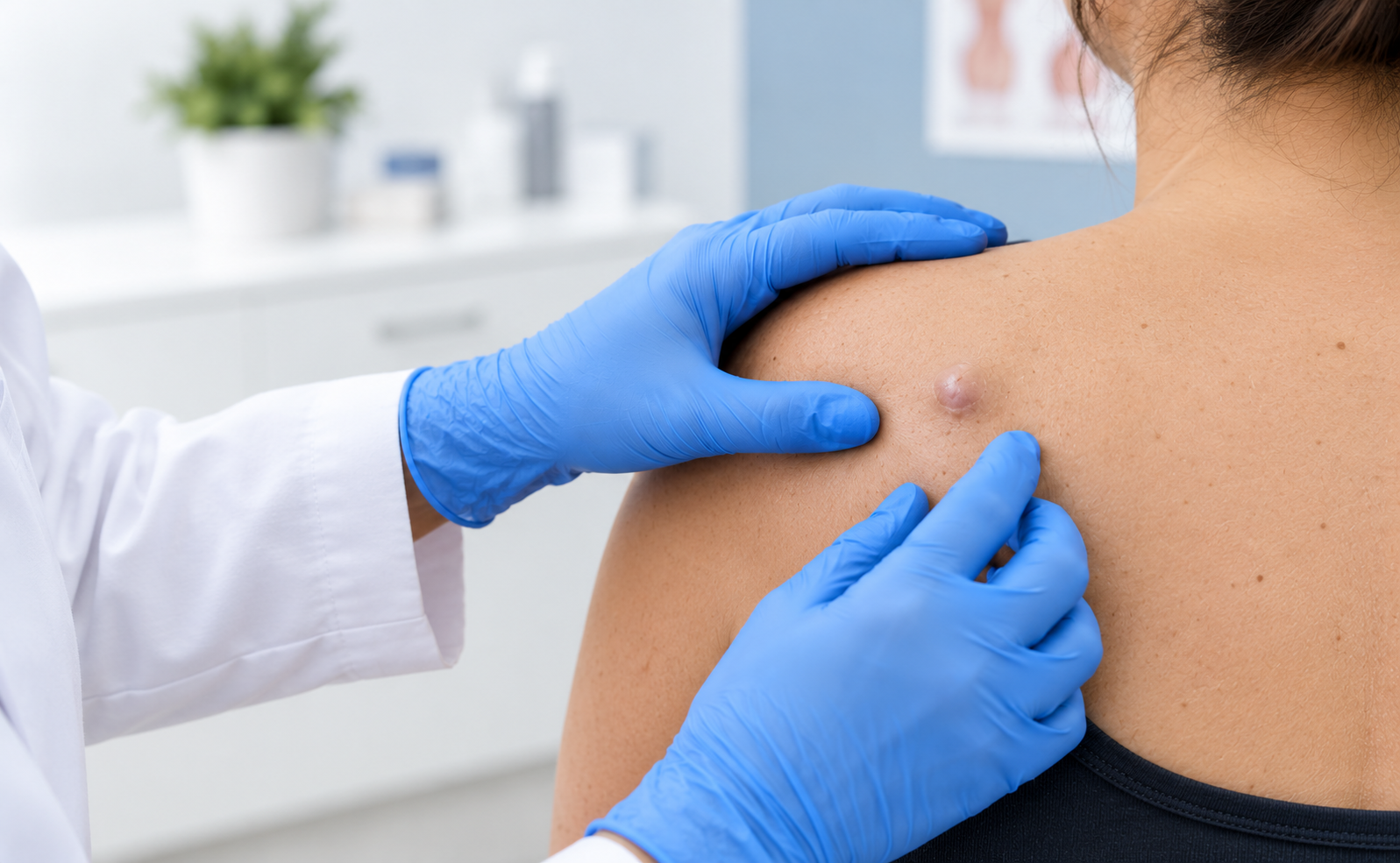
When to get a lump checked promptly
Book an assessment soon if a lump is new, changing, bleeding, hard or fixed, or keeps coming back. Some skin cancers can look like cysts, which is why our skin cancer-trained doctors examine every lump and why removed tissue can be sent for pathology.
Seek medical attention promptly if you develop significant pain, spreading redness, heat, fever or other signs of infection.
What our doctors see most often
We often see patients when a cyst has started growing, become uncomfortable or keeps becoming inflamed. Another common situation is a cyst that has previously been squeezed or drained but has returned because the sac remains beneath the skin. Our approach is to assess the lump first and determine the most appropriate treatment.
Before your appointment
- Tell us about any blood-thinning medication, allergies (including to local anaesthetic), diabetes, or tendency to scar badly or form keloids.
- Wear clothing that gives easy access to the area.
- Don’t squeeze or pick at the cyst beforehand.
- Bring a list of current medications.
How cyst removal works
1
Assessment
We examine the lump and confirm that removal is appropriate.
2
Local anaesthetic
The area is cleaned and numbed. You’ll feel the injection,
then pressure and movement but not sharp pain.
3
Excision
A small incision is made and the cyst is carefully separated from
surrounding tissue and removed with its sac.
4
Closure
The wound is stitched where needed and dressed.
5
Pathology
Excised tissue may be sent to a laboratory to confirm the diagnosis.
6
Aftercare
You receive written wound-care instructions, and we arrange stitch
removal.
Time varies with the cyst’s size, location and condition. Some tenderness is normal once the anaesthetic wears off.
Excision vs drainage
Excision removes the whole cyst including its sac. It’s generally the definitive option for
a suitable cyst and has a lower chance of recurrence.
Drainage releases the contents. It can relieve an acutely inflamed cyst or abscess, but
it doesn’t necessarily remove the cyst wall, so the cyst can refill.
An inflamed or infected cyst may need drainage or antibiotics first, with excision once it has settled. Your doctor will recommend the right approach for the cyst’s current condition.
Please don’t squeeze or cut a cyst at home
Squeezing can force contents into the surrounding tissue and cause inflammation. A needle or non-sterile instrument can introduce bacteria. Even if material comes out, the sac stays beneath the skin and the cyst usually fills again. Home removal can also cause scarring, and the lump may not be a cyst at all.
Recovery and aftercare
You’ll get instructions specific to the site and procedure. Generally:
- Keep the dressing clean and dry for as long as advised.
- Avoid strenuous exercise, swimming, heavy lifting and movements that stretch the wound until your doctor says it’s safe.
- Don’t remove stitches yourself.
- Stitches are usually removed after around 7–10 days, sometimes longer in areas of frequent movement.
Contact us if you notice increasing redness or swelling, significant pain, persistent bleeding, discharge or fever.
Scarring, risks and recurrence
Any incision can leave a scar, and how it looks depends on the cyst’s size and location, your individual healing and wound care. Possible complications include bleeding, infection, wound-healing problems and recurrence. A cyst can return if part of its sac remains, which is why complete excision is the aim. Even then, no one can promise a cyst will never come back. Your doctor will discuss the risks relevant to your procedure before you decide.
How much does cyst removal cost?
Fees depend on the time required and the size, number, location and complexity of the cyst.
| Item | Fee |
|---|---|
Consultation | Dependent on time, size, number, location and complexity. To further enquire: call on this number 03 8202 5959 |
Straightforward cyst excision (from) | Dependent on time, size, number, location and complexity. |
Medicare rebates depend on the clinical circumstances and the item requirements, and cosmetic procedures shouldn’t be assumed to qualify. We’ll explain expected fees, and whether a rebate may apply, before treatment goes ahead.
Who should remove my cyst?
A GP is a sensible first stop for an unexplained lump. Doctors with extra training in skin procedures can assess and remove suitable cysts in clinic, while very large, deep or complex lesions may need a surgeon or dermatologist. If your lump falls outside what we manage, we’ll tell you after assessment and explain the next step.
Why choose Advanced Skin Doctors for cyst removal across Melbourne?
For patients considering cyst treatment, it is useful to know exactly who may be treating you and how the clinic manages the procedure.
Dr Ankur Bansal holds a Master’s of Medicine (Skin Cancer) from the University of Queensland, Bachelor of Medicine, Bachelor of Surgery, Diploma in Skin Cancer Medicine, Diploma in Dermoscopy and Fellowship of the Royal Australian College of General Practitioners. He has more than 18 years of experience in surgical and skin cancer management and performs procedures including the removal of cysts, lipomas, moles and other skin lesions.
Advanced Skin Doctors’ approach includes:
- Assessment before treatment: the lump is examined before determining whether removal is appropriate.
- Surgical cyst excision: where suitable, an incision is made and the cyst and its capsule are removed under local anaesthetic.
- Pathology: excised tissue can be sent for laboratory analysis to confirm its nature and help exclude other diagnoses.
- Aftercare: the treatment site is dressed and patients receive wound-care and follow-up instructions.
- Follow-up: stitch removal is arranged when required according to the procedure and healing.
- Transparent fee structure: cyst and abscess removal fees are based on the time, size, number, location and complexity rather than presenting one price that may not apply to every patient.
- Multiple clinic locations: appointments are available at Narre Warren, Wheelers Hill, Hoppers Crossing and Frankston.
- Direct appointments: the clinic advises that no GP referral is required to make an appointment.
These details allow you to understand the assessment, procedure and expected follow-up before deciding whether cyst removal is right for you.
Facts You Should Know
Cyst Facts for Patients
- Most skin cysts are benign and only need removing if they cause problems.
- Epidermoid cysts are the most common type, usually found on the face, neck and trunk.
- Pilar cysts mostly appear on the scalp and can run in families.
- Draining a cyst often isn’t enough, as it can refill if the sac stays behind.
- Removing the whole cyst with its sac is the best way to reduce the chance of it returning.
- Some skin cancers can look like cysts, so any new or changing lump should be checked.
- Squeezing or cutting a cyst at home can cause infection and scarring.

Frequently asked questions
The area is numbed first, so you shouldn't feel sharp pain. You may feel pressure, and some tenderness afterwards.
Some cysts may settle or occasionally resolve, but many skin cysts persist. If you have a lump that is not disappearing or you are unsure what it is, have it assessed rather than trying to diagnose it yourself.
Removing the whole sac makes this less likely, but it can still happen, particularly if the cyst was infected or previously ruptured.
Yes, a small scar is expected. It usually fades gradually.
Sometimes it shrinks or discharges, but the sac usually remains and the cyst often returns.
Most cysts are benign, but some skin cancers can look similar. That's why we examine every lump carefully and can send removed tissue for pathology.
A cyst is a sac, often with a small surface opening. A lipoma is a soft, doughy lump of fat tissue. We can usually tell them apart on examination.
Usually the infection is treated first, and the cyst is removed once it has settled. Your doctor will advise.
No. You can book directly.


Gallery


