Services Available at Our Skin Clinic Near Lynbrook
For Lynbrook’s community of younger families and adults who may not yet have established a regular skin check routine, there is no better time to start than now. Skin cancer does not discriminate by age – and building an annual check into your health calendar while you are younger means your doctor has a baseline to measure against for years to come.
Full Body Skin Check
A qualified doctor examines your skin methodically from head to toe, including areas that are almost impossible to check properly yourself. Your scalp, the back of your neck, your upper back, the backs of your legs, and the spaces between your toes are all part of a thorough full body check. Your doctor will walk you through any findings clearly at the end of the appointment, and most checks take around 20 to 30 minutes.
Mole Check
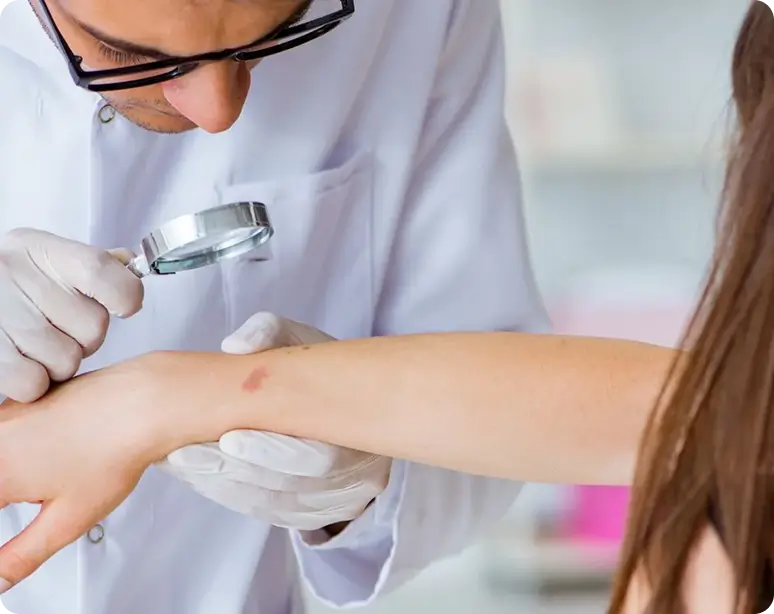
If a mole or spot has been playing on your mind, whether it has recently changed or simply never been looked at by a doctor before – bring it to your appointment. You will leave with a clear clinical answer rather than continuing to wonder about it.
Mole Mapping
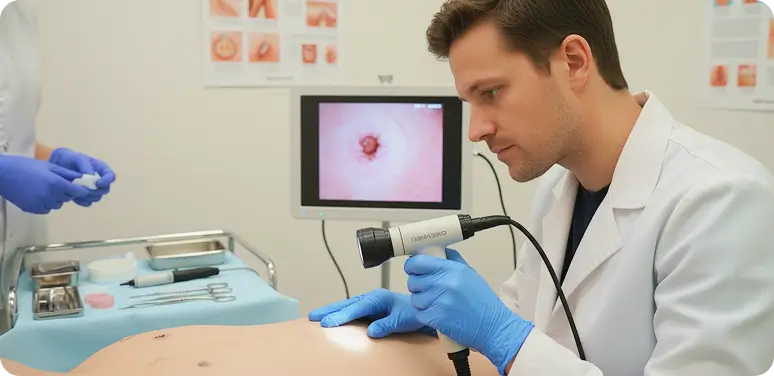
For patients with a large number of moles, a family history of melanoma, or a pattern of significant sun exposure, mole mapping uses detailed imaging to record exactly what your skin looks like right now. That record becomes the reference point your doctor compares against at future visits, making it much easier to spot meaningful changes early.
Skin Cancer Procedures
When a skin cancer is identified and confirmed, your doctor discusses the treatment options and carries out the appropriate procedure based on the type of cancer, its location, and your individual circumstances. The process is explained at every stage before anything proceeds.
Excision & Biopsy
A lesion that raises concern during a skin check may need to be removed in full or sampled for laboratory analysis. Your doctor explains which approach is recommended and why, and performs the procedure at our clinic under local anaesthetic. Results are communicated back to you directly.
Cryotherapy
Certain benign skin lesions and early-stage surface changes can be treated with cryotherapy, a precise freezing method applied to the affected area. Your doctor determines whether this is the appropriate treatment for a specific lesion at the time of your assessment.